
Saul O. Sidore Memorial Foundation
The Saul O. Sidore Memorial Foundation and the Sidore Series are named in memory of the Saul O. Sidore, who was born in New York City in 1907, the son of immigrants. He became involved in the knitting industry in New York in 1931 and moved his business to Manchester, New Hampshire, in 1940, where it was known as Brookshire Knitting Mills and later as Pandora. He died in 1964, after leading the company in a major growth effort that brought employment in Manchester to more than 600 people.
Sidore’s success was based on the theory that following ethical principles is the only sure way to build a business and provide security for its employees. He pioneered a profit sharing-plan, instituted a pension plan, was the first in New Hampshire to employ an industrial psychologist, insured hospitalization benefits for his employees, and founded a scholarship loan fund to send employees’ children to college. He was a member of the New Hampshire Advisory Committee to the U.S. Commission on Civil Rights and was a driving force for the ideals of humanity and brotherhood in Manchester, the state of New Hampshire, and the nation.
The foundation and the series have been established to support campus presentations by speakers on emerging ideas and to enhance faculty efforts to challenge students and the wider community to participate in dialogue around original, provocative, and sometimes controversial issues facing society.
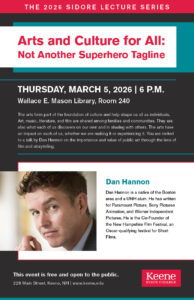 Dan Hannon
“Arts and Culture for All: No Another Superhero Tagline”
Thursday, March 5, 2026 at 6p.m.
Wallace E. Mason Library, Room 240
The Arts form part of the foundation of culture and help share us all as individuals. Art, music, literature, and film are shared among families and communities. They are also what each of us discovers on our own and in sharing with others. The arts have an impact on each of us, whether we are making it or experiencing it.
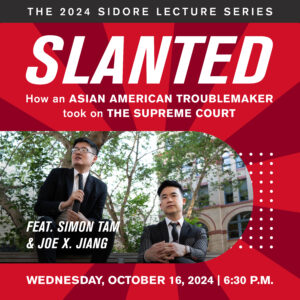
Simon Tam and Joe X. Jiang
“Slanted: How an Asian American Troublemaker took on THE Supreme Court”
Wednesday, October 16, 2024, 6:30p.m.
LP Young Student Center, Mabel Brown Room
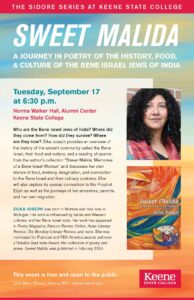 Zilka Joseph
“Sweet Malida: A Journey in Poetry of the History, Food & Culture of the Bene Israel Jews of India”
Tuesday, September 17, 2024
Norma Walker Hall, Alumni Center
Who are the Bene Israel Jews of India? Where did they come from? How did they survive? Where are they now? Zilka Joseph provides an overview of the history of the ancient community called the Bene Israel, their food and culture, and a reading of poems from the author’s collection “Sweet Malida: Memories of a Bene Israel Woman” and discusses her own stories of food, memory, imagination, and connection to the Bene Israel and their culinary customs. She will also explore its special connection to the Prophet Elijah as well as the journeys of her ancestors, parents and her own migration.
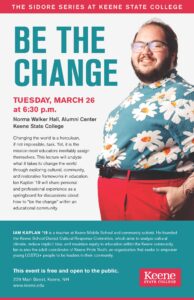 Ian Kaplan
“Be the Change”
Tuesday, March 26, 2024 at 6:30p.m.
Norma Walker Hall, Alumni Center
Changing the world is a herculean, if not impossible take. Yet, it is the mission most educators inevitably assign themselves. This lecture will analyze what it takes to change the world through exploring cultural, community, and restorative frameworks in education. Ian Kaplan “19 will share personal and professional experiences as a springboard for discussions about how to “be the change” within an educational community.
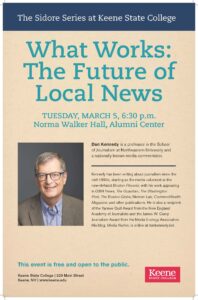 Dan Kennedy
“What Works: The Future of Local News”
Tuesday, March 5, 2024 at 6:30p.m.
Norma Walker Hall, Alumni Center
Kennedy has been writing about journalism since the mid-1990s, starting as the medial columnist at the now-defunct Boston Phoenix, with his work appearing in GBH News, The Guardian, The Washington Post, The Boston Globe, Nieman Lab, CommonWealth Magazine, and other publications. He is also a recipient of the Yankee Quill Award from the New England Academy of Journalists and the James W. Carey Journalism Award from the Media Ecology Association. His blog, Media Nation, is online at dankennedy.net.
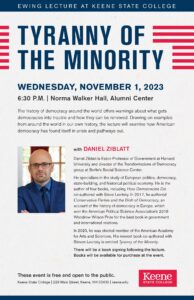 Daniel Ziblatt
“Tyranny of the Minority”
Wednesday, November 1, 2023 at 6:30p.m.
Norma Walker Hall, Alumni Center
The history of democracy around the world offers warnings about what gets democracies into trouble and how they can be renewed. Drawing on examples from around the world in our own history, the lecture will examine how American democracy has found itself in crisis and pathways out.
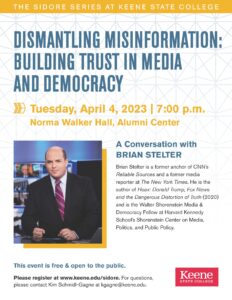 Brian Stelter
“Dismantling Misinformation: Building Trust in Media and Democracy”
Tuesday, April 4, 2023 at 7p.m.
Norma Walker Hall, Alumni Center
Brian Stelter is a former anchor of CNN’s Reliable Sources and a former media reporter at The New York Times. He is the author of Hoax: Donald Trump, FOX News and the Dangerous Distortion of Truth (2020) and is the Walter Shorenstein Media & Democracy Fellow at Harvard Kennedy School’s Shorenstein Center on Media, Politics, and Public Policy.
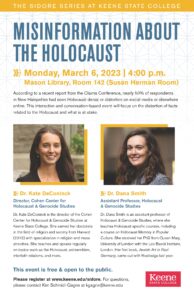 Kate DeConick and Dana Smith
“Misinformation about the Holocaust”
Monday, March 6, 2023 at 4p.m.
Mason Library, Room 142
According to a recent report from the Claims Conference, nearly 50% of respondents in New Hampshire had seen Holocaust denial or distortion on social media or elsewhere online. This interactive and conversation-based event will focus on the distortion of facts related to the Holocaust and what is at stake.
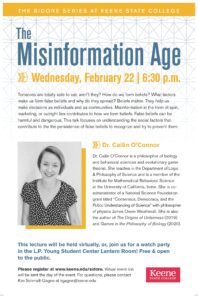 Cailin O’Connor
“The Misinformation Age”
Wednesday, February 22, 2023 at 6:30pm
Watch Party LP Young Student Center, Lantern Room
Tomatoes are totally safe to eat, aren’t they? How do we form beliefs? What factors make us form false beliefs and why do they spread. Beliefs matter. They help us make decisions as individuals and as communities. Misinformation in the form of spin, marketing, or outright lies contributes to how we form beliefs. False beliefs can be harmful and dangerous. This talk focuses on understanding the social factors that contribute to the persistence of false beliefs to recognize and try to prevent them.
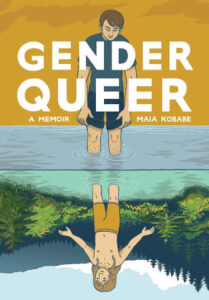
Gender Queer Book Club
Monday, November 21, 2022 at 7p.m.
Mason Library, Cohen Center
Gender Queer is a graphic memoir that was the most challenged book in the US in 2021, Join us for refreshments and conversation about everything from format, to the ideas, to the controversy.
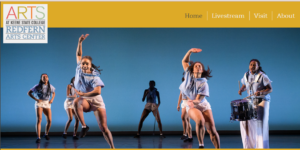
Urban Bush Women
Tuesday, October 25, 2022 at 6p.m.
Redfern Arts Center, Main Theatre
Urban Bush Women is telling Black Women’s Stories with intention and kindness. Hitting it hard like Betty Davis and Tina Turner. Stayin in discomfort to get us to the nest space of our brilliance. Urban Bush Women is a groundbreaking Black women-led theatrical dance company and social activism ensemble, founded in 1984 by visionary choreographer Jawole Willa Jo Zollar as an engine and amplifier of the unheard stories of Black Women. Urban Bush Women combines revolutionary performance, deep-healing community engagement, and ancestral knowledge from the African diaspora into a cultural force that is urgent, forward-looking, and essential.
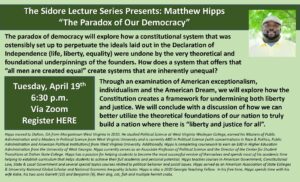
Matt Hipps
“The Paradox of Our Democracy”
Tuesday, April 19, 2022 at 6:30p.m.
Via Zoom
The paradox of democracy will explore how a constitutional system that was ostensibly set up to perpetuate the ideals laid out in the Declaration of Independence (life, liberty, equality) were undone by the very theoretical and foundational underpinnings of the founders. How does a system that offers that “all men are created equal” create systems that are inherently unequal? Through the examination of American exceptionalism, individualism and the American Dream, we will explore how the Constitution creates a framework for undermining both liberty and justice. We will conclude with a discussion of how we can better utilize the theoretical foundations of our nation to truly build a notion where there is “liberty and justice for all.”
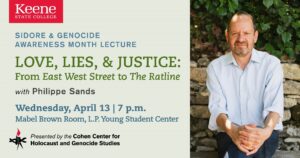
Philippe Sands
“Love, Lies, & Justice: From East West Street to The Ratline“
Wednesday, April 13, 2022 at 7p.m.
LP Young Student Center, Mabel Brown Room
Professor Sand’s book “East West Street” examines the stories of the two men who, simultaneously, in the same city, and unknow to each other, originated the concepts of “genocide” and “crimes against humanity”.
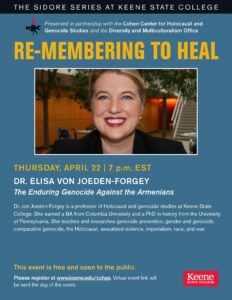
Elisa Von Joeden-Forgey
“The Enduring Genocide Against the Armenians
Thursday, April 22, 2021 at 7p.m.
Via Zoom
Dr. von Joeden-Forgey is a professor of Holocaust and Genocide studies at Keene State College. She earned a BA from Columbia University and a PhD in history from the University of Pennsylvania. She teaches and researches prevention, gender and genocide, comparative genocide, the Holocaust, sexualized violence, imperialsim, race, and war.
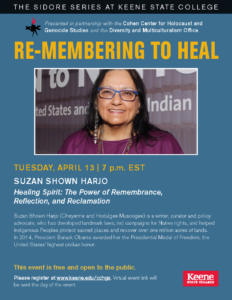
Suzan Shown Harjo
“Healing Spirit: The Power of Remembrance, Reflection, and Reclamation”
Tuesday, April 13, 2021 at 7p.m.
Via Zoom
Suzan Shown Harjo (Cheyenne and Hodulgee Muscogee) is a writer, curator and policy advocate, who has developed landmark laws, led campaigns for Native rights, and helped Indigenous Peoples protect sacred placed and recover over one million acres of lands. In 2014, President Barak Obama awarded her the Presidential Medal of Freed, the United States’ highest civilian honor.
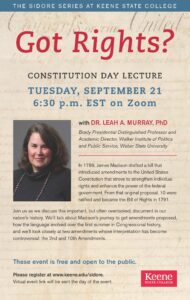
Leah Murray
“Got Rights?”
Tuesday, September 21, 2020 at 6:30p.m.
Via Zoom
In 1789, James Madison drafted a bill that introduced amendments to the US Constitution that strove to strengthen individual rights and enhance the power of the federal government. From that original proposal, 10 were ratified and became the Bill of Rights in 1791. Join us as we discuss this important, but often overlooked, document in our nation’s history. We’ll talk about Madison’s journey to get amendments proposed, how the language evolved over the first summer in Congressional history, and we’ll look closely at tow amendments whose interpretation has become controversial: the 2nd and the 10th Amendments.
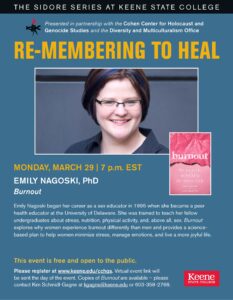
Emily Nagoski
“Burnout”
Monday, March 29, 2020 at 7p.m.
Via Zoom
Emily Nagoski began her career as a sex educator in 1995 when she became a peer health educator at the University of Delaware. She was training to teach her fellow undergraduates about stress, nutrition, physical activity, and, above all, sex. Burnout explores why women experience burnout differently than mean and provides a science-based plan to help women minimize stress, manage emotions, and live a more joyful life.
Dan Froot and Company
“Pang”
Wednesday, March 17, 2020 at 6p.m.
Via Zoom
Live from California, the celebrated theater ensemble Dan Froot and Company performs Pang!, a triptych of adventurous live radio plays based on the oral histories of three American families hungering for change. The three highly original theatre pieces share the stories of families facing innumerable challenges – from hunger to gun violence to foreclosure to immigrant life – with love, humor and intelligence. Pang! aims to raise awareness, decrease stigma, and promote cross-class dialogue around circumstances faced by families living with food insecurity.
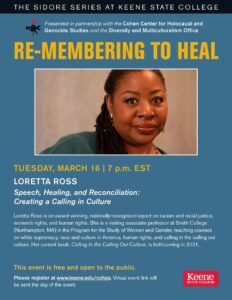
Loretta Ross
“Speech, Healing, and Reconciliation: Creating a Calling in Culture”
Tuesday, March 16, 2020 at 7p.m.
Via Zoom
Loretta Ross is an award-winning, nationally-recognized expert on racism and social justice, women’s rights, and human rights. She is a visiting associate professor at Smith College in the Program for the Student of Women and Gender, teaching courses on white supremacy, race and culture in America, human rights, and calling in the calling out culture. Her current book, Calling in the Calling Out Culture, is forthcoming in 2021.
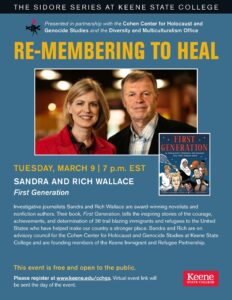
Rich and Sandra Wallace
“First Generation”
Tuesday, March 9, 2020
Via Zoom
Investigative journalists Sandra and Rich Wallace are award-winning novelists and nonfiction authors. Their book, First Generation, tells the inspiring stories of the courage, achievements, and determination of 36 trailblazing immigrants and refugees to the United States who have helped make our country a stronger place. Sandra and Rich are on the advisory council for the Cohen Center for Holocaust and Genocide studies at Keene State College and are founding members of the Keene Immigrant and Refugee Partnership.
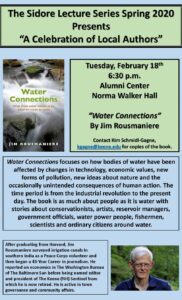
Jim Rousmaniere
“Water Connections”
Tuesday, February 18, 2020 at 6:30p.m.
Norma Walker Hall, Alumni Center
Water Connections focused on how bodies of water have been affected by changes in technology, economic values, new forms of pollution, new ideas about nature and the occasionally unintended consequences of human action. The time period is from the industrial revolution to the present day. The book is as much about people as it is water with stories about conservationists, artists, reservoir managers, government officials, water power people, fishermen, scientists, and ordinary citizens around water.
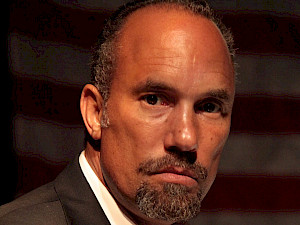
Roger Guenveur Smith
“Otto Frank”
Thursday, October 17, 2019 at 7:30p.m.
Redfern Arts Center, Main Theatre
Acclaimed stage and screen actor Roger Guenveur Smith returns to Keene with a stirring new solo performance piece exploring the story and legacy of Anne Frank’s father, Otto Frank. Inspired by research initiated at Keene State College, and presented as a Sidore Lecture performance in conjunction with the 36th anniversary of the Cohen Center for Holocaust and Genocide Studies. Smith (credits include Do the Right Thing, The Birth of a Nation, Rodney King) blends the historical and performative in a piece about the man who lives on past loss to share his family’s experiences and memories through his daughter’s famous diary.
Tom Ehrlich
“A Political Imperative”
Tuesday, April 9, 2019 at 7 p.m.
Norma Walker Hall, Alumni Center
In a time of deep crisis in American Democracy, Tom Ehrlich will discuss how and why college students must be actively engaged in politics and public policy issues.
Tom Ehrlich is a consulting professor at the Stanford University Graduate School of Education. Dr. Ehrlich has served as president of Indiana University, provost of the University of Pennsylvania, dean of the Stanford Law School, and senior scholar at the Carnegie Foundation for the Advancement of Teaching. He is author, coauthor, or editor of 14 books that address topics including international law, education, and public service
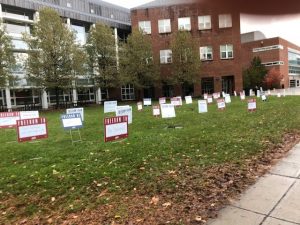
Four Freedoms Public Art Display
Monday October. 29, 2018, 8a.m. to 5p.m.
L.P. Young Student Center, Front Lawn
Members of the Keene State College Community will be invited to participate in a public art project on campus consisting of handmade yard signs as part of the For Freedoms 50 State Initiative for civic engagement.
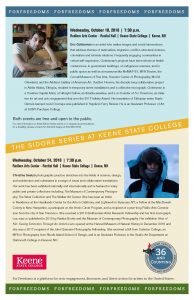
Christina Seeley, Wednesday, Oct 24, 2018 at 7:30pm
For Freedoms
Eric Gottesman, Wednesday, Oct 10, 2018 at 7:30pm
Christina Seely’s photographic practice stretches into the fields of science, design, and architecture and culminates in a range of visual and collaborative translations. Her work has been exhibited nationally and internationally and is featured in many public and private collections including; The Museum of Contemporary Photography, The West Collection and The Walker Art Center. She has been an Artist in Residence at the Headlands Center for the Arts in California, and Lightwork in Syracuse, NY, a Fellow at the MacDowell Colony in New Hampshire, a participant on the Arctic Circle Program, and a recipient of a year-long Public Arts Commission from the city of San Francisco. She received a 2014 Smithsonian Artist Research Fellowship and her first monograph Lux, was co-published in 2015 by Radius Books and the Museum Photography Fellowship. S
Eric Gottesman is an artist who makes images and social interventions that address themes of nationalism, migration, conflict, structural violence, colonialism and intimate relations. Frequently engaging communities in critical self-expression, Gottesman’s projects have been shown at health conferences, in government buildings, on indigenous reserves, and in public space as well as at museums like MoMA/PS1, MFA Boston, the Cornell Museum of Fine Arts, Houston Center of Photography, MoCA Cleveland, and the Addison Gallery of American Art. Sudden Flowers, his decade-long collaborative project in Addis Ababa, Ethiopia, resulted in temporary street installations and a collective monograph. Gottesman is a Creative Capital Artist, a Fulbright Fellow, an Artadia awardee, and a co-founder of For Freedoms.
 Ayub Nuri
“The Struggle to Develop a Kurdish Independent State”
Monday, March 19, 2018 at 7p.m.
LP Young Student Center, Mabel Brown Room
Kurds of Iraq attempted to break away from Baghdad and form an independent state manifested themselves in a popular referendum on September 25, 2017. And how, after two solid decades of alliance with the United States and the West, the Kurds were betrayed and abandoned after the referendum and seem poised to be crushed by the Iraqi army. Despite the setbacks of 2017, for Kurds, it’s unlikely that their aspirations for statehood have died.
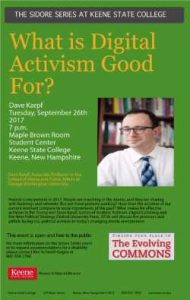
David Karpf
“What is Digital Activism Good For?
Tuesday, September 26, 2017 at 7p.m.
LP Young Student Center, Mabel Brown Room
Does it seem that the internet is just a place to share cat videos and rant about politics? What if the internet could be a place to create social change? On Tuesday September 26th at 7 p.m. in the Mabel Brown Room, we are welcoming David Karpf for his lecture titled “ What is Digital Activism Good For?” as a part of the Sidore Lecture Series. This lecture will cover the promises and pitfalls facing U.S. political activists in today’s changing media environment during controversial Trump era.

Dr. Barry Clark
“Economic Inequality: Causes, Consequences, and Solutions”
Tuesday, October 25, 2016 at 7p.m.
LP Young Student Center, Mabel Brown Room
The statistics reveal a dramatic increase in inequality over the past three decades, but the causes – and consequences – of this trend remain in dispute. Although some inequality is essential to a healthy economy, inequality may have become so excessive that, in the words of President Obama, it poses “a fundamental threat to the American dream, our way of life, and what we stand for around the globe.” If the degree of inequality has grown beyond a sustainable level, what can be done to achieve a more just society without jeopardizing the prosperity supporting widespread opportunities for social mobility?

Curtis Chen
“Tested”
Tuesday, October 4, 2016 at 6:30p.m.
LP Young Student Center, Mabel Brown Room
The gap in opportunities for different races in America remains extreme. Nowhere is this more evident than our nation’s top public schools. This documentary follows a dozen raciallyand socio-economically diverse 8th graders as they fight for a seat at one of these schools. Their only way in: to ace a single standardized test.Testedexplores such issues as access to a high-quality public education, affirmative action, and the model-minority myth.
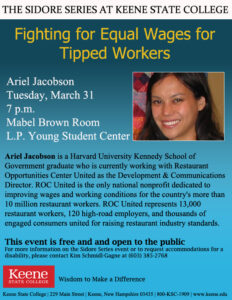
Ariel Jacobson
“Fighting for Equal Wages for Tipped Workers
Tuesday, March 31, 2015 at 7p.m.
LP Young Student Center, Mabel Brown Room
ROC United was launched in January 2008 based on calls for support from around the country. Most restaurant workers earn the bulk of their income through tips. With the federal tipped minimum wage being $2.13 an hour and lower than the regular minimum wage in most states, their base pay results in $0 paychecks. Although some restaurant workers do make great money living off tips, they are the exception. © ROC United. Ariel Jacobson will be discussing the facts above as well as much more! For more information about ROC United please visit http://rocunited.org/ .

Richard Rubin
“The Last of the Doughboys Voices from the ‘War to End All Wars'”
Wednesday 17, 2014 at 7p.m.
LP Young Student Center, Mabel Brown Room
Richard Rubin is author of several books and a contributor to The Atlantic Monthly and The New York Times Magazine, among other publications. His most recent book, The Last of the Doughboys, is a conversational history of America’s experience in World War I, as recalled by its last surviving veterans.
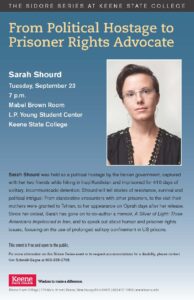 Sarah Shourd
“From Political Hostage to Prisoner Rights Advocate”
Tuesday, September 23, 2014 at 7p.m.
LP Young Student Center, Mabel Brown Room
From 2009 to 2010 Sarah Shourd was held as a political hostage by the Iranian government, captured with her two friends while hiking in semi-autonomous Iraqi Kurdistan and imprisoned—without due process or any evidence shown against her—for 410 days of solitary, incommunicado detention. In this talk Shourd will tell stories of resistance, survival and political intrigue: from clandestine encounters with other prisoners, to the visit their mothers were granted to Tehran, her appearance on Oprah days after her “compassionate” release and subsequent meetings with figures such as Hilary Clinton, President Obama, Actor Sean Penn, Boxer Muhammad Ali and President Ahmadinejad himself. Since her ordeal, Sarah has gone on to co-author a memoir, A Sliver of Light: Three Americans Imprisoned in Iran, and to speak out about a wide range of human and prisoner rights issues, focusing on the widespread use of prolonged solitary confinement in US prisons.
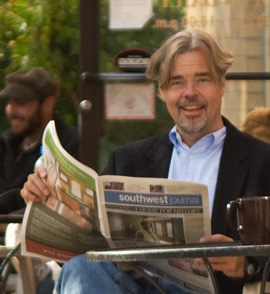
Jay Walljasper
“The (Re)Discovery of the Commons: A Path Toward a Greener, More Equitable and Happier World”
Tuesday, April 15, 2014 at 7p.m.
LP Young Student Center, Mabel Brown Room
The commons is a new use of an old word, meaning “what we share”—and it offers fresh hope for a saner, safer, more enjoyable future. The commons refers to a wealth of valuable assets that belong to everyone, ranging from clean air to wildlife preserves; from the judicial system to the Internet. Some are bestowed to us by nature; others are the product of cooperative human creativity. Anyone can use the commons, so long as there is enough left for everyone else.
Jay Walljasper is editor of Commons Magazine at OnTheCommons.org and Senior Fellow at On the Commons. He writes, speaks, and consults regularly on how new ideas in urban planning, economic development, tourism, sustainability, and the commons can improve our lives and communities. He is the author of All That We Share: A Field Guide to the Commons and The Great Neighborhood Book: A Do-It-Yourself Guide to Placemaking (with Project for Public Spaces). He was formerly editor of Utne Reader magazine and a contributing editor at National Geographic Traveler.

Billy Stream
“Victory of the Commons? Community, Hospitality, Intelligence, and Exhilarated Learning
Monday, April 15, 2023 at 7p.m.
Centennial Hall, Alumni Center
As rational as self-interest may be, it can destroy the group’s long-term best interests. Preserving the greater good and promoting the heart of higher education can be accomplished by understanding “community” as an ontological reality, an epistemological necessity, a pedagogical asset, and an ethical corrective. As individuals, we can cultivate “hospitality intelligence,” a set of attributes characterized by loving heart, gentle spirit, respectful attitude, and open arms. When applied to a learning environment, the cultivation of these attitudes and practices forms the basis for human connection, one of the cornerstones of “Exhilarated Learning.”
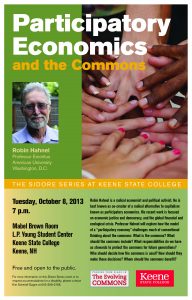
Robin Hahnl
“Participatory Economics and the Commons”
Tuesday, October 8, 2013 at 7pm
LP Young Student Center, Mabel Brown Room
What is the commons? What should the commons include? What responsibilities do we, the present generation, have as stewards to protect the commons for future generations? Who should decide how the commons is used? How should they go about making those decisions? Who should the commons benefit? Professor Hahnel will explore how the model of a “participatory economy” challenges much of conventional thinking about the commons.
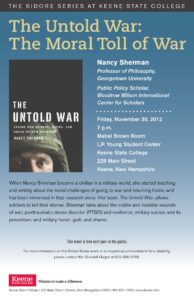 Nancy Sherman
“The Untold War: The Moral Toll of War”
Friday, November 30, 2012 at 7p.m.
LP Young Student Center, Mabel Brown Room
The Untold War is my best effort at allowing soldiers to open up their hearts and tell their stories. I have listened to those stories with the ear of a philosopher and psychoanalyst, but also with the ear of a daughter, who always felt that she needed to understand more about what her father went through. And I have analyzed those stories in language that steps outside the academy—in terms my dad would have understood. I talk about the visible and invisible wounds of war; posttraumatic stress disorder (PTSD) and resilience; military suicide and its prevention; military honor, guilt, and shame. Military families need to know that we who do not have loved ones serving are doing our best to understand and help those who do.
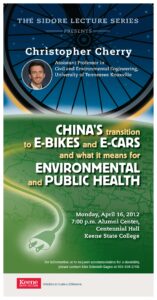
Chris Cherry
“China’s Transition to E-Bikes and E-Cars and what it Means for Environment and Public Health”
Monday, April 16, 2012 at 7p.m.
Centennial Hall, Alumni Center
Dr. Cherry received his Ph.D. from the University of California Berkeley, in Civil and Environmental Engineering-Transportation. He also has a Minor in City and Regional Planning and Economics. For his dissertation he chose the topic: Environmental, Safety and Mobility Implications of Electric Two-Wheeler Use In China. He completed both his Masters and Bachelors of Science in Civil Engineering-Transportation from the University of Arizona. Dr. Cherry’s research interest areas include: Transportation Needs of Rapidly Developing Countries-specifically China, Multimodal Transportation Planning and Operations, Public Transportation Systems, Travel Behavior and Demand, Transportation Economics, Transportation and the Environment and Transit Security. Dr. Cherry has published articles on topics including lead emissions from solar photovoltaic energy systems in China and India, subway station design and the lessons learned from case studies of contemporary terrorism incidents, planning for the Bay area regional express bus service, systems level approaches to sustainable urban arterial revitalization, the development of duration models to determine rolling fleet size, designing map based transit itinerary planners and analyzing freeway improvements for express bus service.

Stephanie Kaza
Wednesday, March 23, 2011
“Embracing the Deep View: Skillful Means on the Path to Sustainability”
We face environmental concerns with sober awareness, recognizing the political, economic and social constraints that limit our actions. Lifestyle change and institutional commitment are only part of the path to sustainability. We must also consider the ethics and values behind our choices to find an appropriate moral compass for this work.

Paul Gorski
“Beyond the ‘Culture of Poverty’ Myth: Creating Equitable Classrooms and Schools”
Thursday, March 25, 2010
Decades of social science research demonstrate that low-income people share no consistent and predictable culture, but the “culture of poverty” myth persists. Based almost entirely upon false stereotypes, this approach perpetuates the very inequities it seeks to eliminate. A more authentic approach to educational equity requires a careful look at educational systems and practices that deny low-income families opportunities that their wealthier peers take for granted. In this presentation, Dr. Gorski will explore those systems and practices and discuss strategies for eliminating economic injustice from our classrooms, schools, and society.

Geoffrey Giles
“The Gay Threat and the Nazi Imagination”
Monday, February 1, 2010
During World War II-era Nazi Germany and the Holocaust, thousands of homosexuals, primarily gay men, perished in concentration camps, along with millions of Jews and other victims, including Roma (Gypsies), Poles, Soviet prisoners of war, Jehovah’s Witnesses, and the handicapped. Dr. Giles will look at what happened to homosexuals in Nazi Germany and explore what we can learn from this history with regard to homophobia in our culture today.
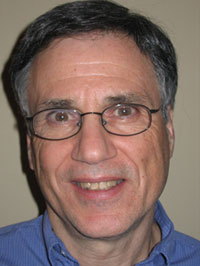
Stephen Shalom
“Can We End the Unending Conflict?: Reflections on Israel and Palestine”
Monday, April 27, 2009
Professor Shalom has written and spoken widely on U.S. foreign policy and on the Middle East. Among his books are Imperial Alibis: Rationalizing U.S. Intervention after the Cold War andWhich Side Are You on? An Introduction to Politics. He is the editor of a dialogue between Noam Chomsky and Gilbert Achcar, Perilous Power: the Middle East and U.S. Foreign Policy. He serves on the editorial board of New Politics and is a regular contributor to Z Magazine and ZNet. He was in Jordan, Syria, and Lebanon this past year.
 Nancy Folbre
“The Political Economy of Care”
Monday, April 16, 2009 at 7p.m.
LP Young Student Center, Mabel Brown Room
Time is not money. If anything, it is more important than money. The time we have to care for one another, especially for our children and our elderly, is more precious to us than anything else in the world. Yet we have more experience accounting for money than we do for time.

Tamara Draut
“Falling Behind: The Economic Challenges Confronting a New Generation and What We Can Do About It”
Tuesday, March 24, 2009 at 7p.m.
Rhodes Hall, Room S203
Tamara Draut is the author of Strapped: Why America’s 20- and 30 Somethings Can’t Get Ahead and is the Vice President for Policy and Programs at Demos. He research focuses on the growing debt burdens facing low-and middle-income households, and more broadly the challenges confronting households trying to work or educate their way into the middle class.
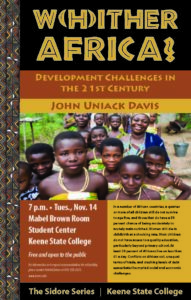 John Uniak Davis
“W(H)ITHER AFRICA? Development Challenges in the 21st Century”
Tuesday, November 14, 2008 at 7p.m.
LP Young Student Center, Mabel Brown Room
In a number of African countries, a quarter or more of all children still do not survive to age five, and those that do have a 50 percent chance of being moderately to acutely malnourished. Women still die in childbirth at a shocking rate. Most children do not have access to a quality education, particularly beyond primary school. At least 50 percent of Africans live on less than $1 a day. Conflicts on African soil, unequal terms of trade, and crushing levels of debt exacerbate the myriad social and economic challenges.

Anwar Shaikh
“Globalization and the Myths of Free Trade”
Thursday, October 5, 2008 at 7p.m.
LP Young Student Center, Mabel Brown Room
Over one billion people (one-fifth of the world’s population) live on less than $1 a day. Over half a million women die each year (one per minute) from complications in pregnancy and childbirth (UNFPA.org). More than one-third of the people of Sub-Saharan African are undernourished (worldhunger.org). These horrors persist even though the resources exist toprovide adequate nutrition and health care to all of the world’s people. While economists claim that unrestricted free trade is the surest path out of poverty for the poorest of the world’s people, the gap between the wealthiest and the poorest parts of the world has exploded in recent decades of unprecedented globalization. International trade theory stops being mysterious as soon as one recognizes that real international competition works in the same way as national competition: it favors the competitively strong over the competitively weak.
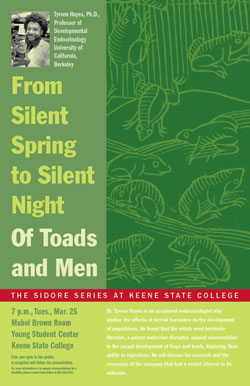
Dr. Tyrone Hayes
“From Silent Spring to Silent Night of Toads and Men”
Tuesday, March 25, 2008 at 7p.m.
LP Young Student Center, Mabel Brown Room
Dr. Tyrone Hayes, a professor in the department of Integrative Biology at the University of California, Berkeley, will present “From Silent Spring to Silent Night of Toads and Men”.
Dr. Hayes is an acclaimed endocrinologist who studies the effects of steroid hormones on the development of frogs and toads. He found that the widely used herbicide Atrazine, a potent endocrine disrupter, caused abnormalities in the sexual development of frogs and toads, hindering their ability to reproduce. He will discuss his research and the responses of the company that had a vested interest in its outcome.
 Dr. Michael Shannon M.D., M.P.H., Marni A. Silverstein M.D. & Katie Lajoie R.N., B.A., B.S.N.
Childhood Lead Poisioning”
Wednesday, October 17, 2007
Lead is a toxic metal that can cause a range of health issues, from behavioral problems and learning disabilities to seizures and death. In the 1980s, the use of lead was phased out of gasoline and paint, but in New England, where many buildings are more than 25 years old, many of our houses may still contain lead paint. Exposure to lead usually occurs because of deteriorating lead-based paint, lead-contaminated dust (particularly from renovations), and lead-contaminated residential soil. Children 6 years old and under are most at risk because their bodies are growing quickly. Even seemingly healthy children can have high levels of lead in their bodies. This symposium brings three experts in the field to help inform parents and community members about this issue:
Dr. Michael Shannon will open with Healthy People 2010: Eradication of Childhood Lead Poisoning – Will the Promise Be Fulfilled? A pediatrician for more than 25 years, Dr. Shannon is chief emeritus of Emergency Services at Children’s Hospital Boston, as well as professor and chair of Pediatrics at Harvard Medical School. He is the associate director of the Children’s Hospital Pediatric Environmental Health Center at Children’s, a Pediatric Environmental Health Specialty Unit (PEHSU) serving EPA Region I, and the senior consulting toxicologist for the MA/RI Poison Control Center.
Local pediatrician Dr. Marni A. Silverstein will follow with Lead and Your Child: What Your (Child’s) Doctor Does Want You to Know! Dr. Silverstein is a pediatrician at Cheshire Medical Center/Dartmouth-Hitchcock Keene, interacting with children and their parents on a wide range of pediatric issues. She received her bachelor’s degree in neuroscience and behavior from Wesleyan University in Middletown, Connecticut, and her Doctor of Medicine degree from the University of Massachusetts Medical School in Worcester, Massachusetts. She completed her residency training at Dartmouth Hitchcock Medical Center in Lebanon, New Hampshire. She has been in Keene since 2004.
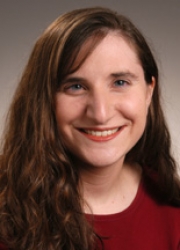 Public health nurse Katie Lajoie will conclude with What Parents Can Do. Lajoie is a Public Health Nurse case manager in the Childhood Lead Poisoning Prevention Program of the New Hampshire Department of Health and Human Services. She has worked for the Department of Health and Human Services since 1985 and in the Childhood Lead Poisoning Prevention Program since 1990. In this role she provides counseling to parents and other members of the public about lead poisoning and its prevention; serves as a liaison between community health providers, environmental inspectors, and primary health care providers; and helps to ensure children’s care throughout the process, from case identification to case resolution.

Kenneth Hardy
“Diverse and Oppressed Families: It’s About All of Us.”
Monday, April 3, 2006
Dr. Kenneth Hardy will present three lectures on Monday, April 3, and Tuesday, April 4, as part of the Sidore Series event “Facing Race and Class Oppression.”Dr. Hardy is a professor in the Department of Marriage and Family Therapy at Syracuse University and a senior faculty at the Ackerman Institute for the Family. He co-authored Teens Who Hurt: Clinical Interventions to Break the Cycle of Adolescent Violence, and has appeared on the Oprah Winfrey Show, Dateline NBC, 20/20, and PBS.