September 17 – December 12, 2026
SEQUENT
SHAINA GATES
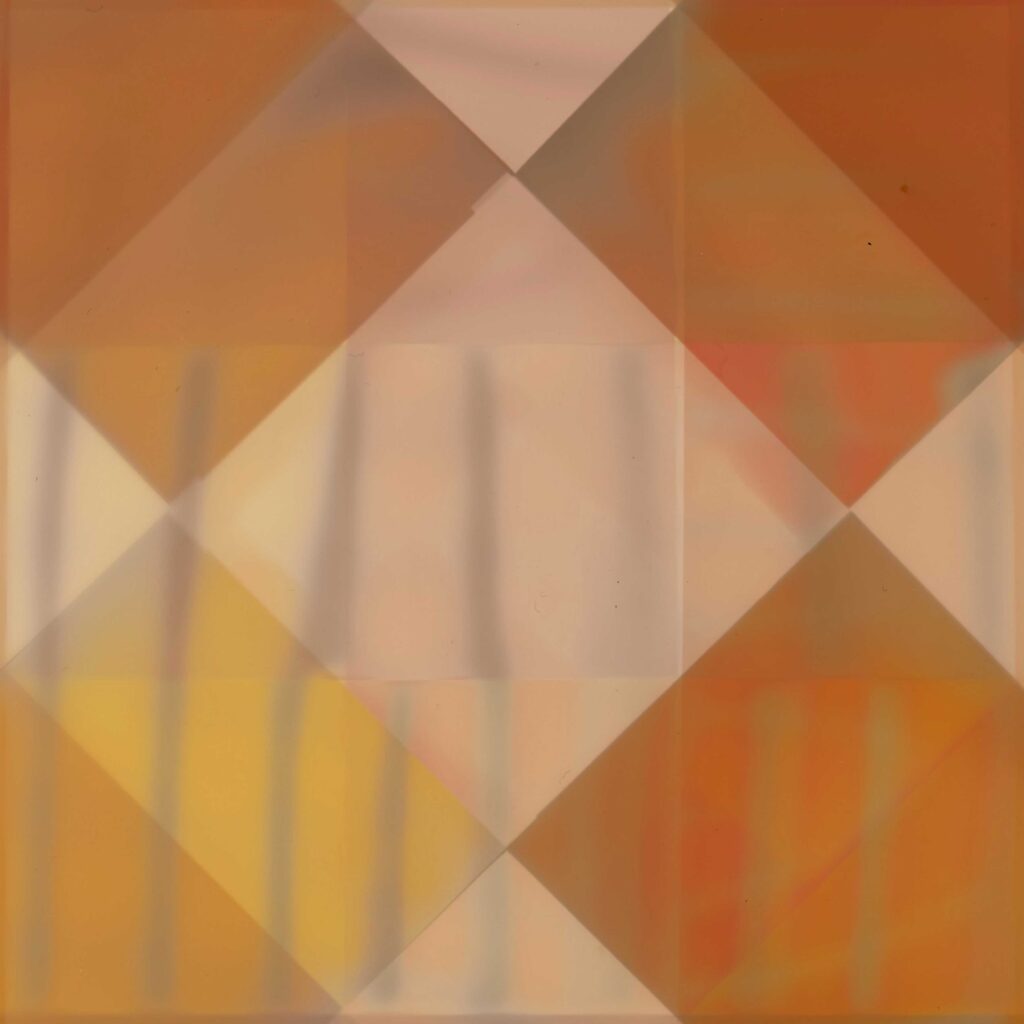
This is black and white film.
I have several post-it notes in my studio stating so—I write it down once in a while to remind myself. It still amazes me that so much color can be produced from a material intended only to capture black and white images.
PROCESS
A sheet of black and white film is exposed to the the sun or other intense light source (e.g. UV or grow light). A visible image or pattern of colors forms during the exposure. Then the film is fixed, only to preserve the color and prevent further exposure. There are no dyes, toners, developers, or otherwise that are used to produce the color. The color is entirely self-contained, and self-materialized by the black and white film itself.
THE FILM
The variety of color depends on many different factors, all of those that I know, I will list here: exposure time, light quality, time of day, color (intentional and atmospheric), heat, humidity, the specific type of black and white film, along with its history of storage (which is often a mystery), and so many other factors yet to be discovered.
The black and white photographic emulsion is made up of silver halide particles suspended in a gelatin layer, which, when exposed to light, are then able to become metallic silver in the presence of developing chemistry—seen as black and gray in a black and white photograph. In my work however, the silver particles are activated by the longer exposures, and begin to oxidize and darken on their own. As they are doing so, the silver is also affected by the environmental conditions (light color, heat, etc.), as well as any particular additives in the emulsion itself. Because of all this, the silver particles shape themselves into different crystal structures at the microscopic level…which then reflect light back to our eyes, perceived as variations in color.
CURRENT WORK
In this body of work, I have focused my attention on the use of colored filters to manipulate the exposure. More specifically, the sequence of colors used, and how differing orders of the same sets of colors will produce different results. For example, if a red filter is placed on the film for a 4 minute exposure, and then a cyan filter for another 4 minute exposure, this will produce a particular color on a particular sheet of film. YET, if the order is reversed: so that a cyan, then ared filter are used—for the same 4 minute exposures each—that color will be different than the first result. From a photosynthetic/chemical perspective, this makes sense. But it is not intuitive when thinking about color in a typical additive/subtractive or pigment/light-based way. This discovery came to me a few years ago, and has influenced decisions in my work since then.
This show is selection of experiments using this sequential patterning of color filters, through multiple exposures on the same film pieces. To organize the particular exposure/filter sequences, I have imposed different color systems onto base 2, 3 and 4 number systems—to correspond with pairs of color, RGB, and CMYK sets. This gives me an underlying structure to follow in order to realize each permutation within a set of ordered colors.
The geometric forms—initially useful for comparing experimental results in a consistent way—have become quilt-like. I have leaned into this, designing sets of “quilt blocks” out of the filters, which can then be sequenced to create complete sets of combinations through ordered exposures on the film.
I continue to be surprised by this process. I am most gratified when I am working as a witness and a mediator in the system—the conditions of exposure adjusted and repeated over and over to reveal as many variations and as much color as the film is able.
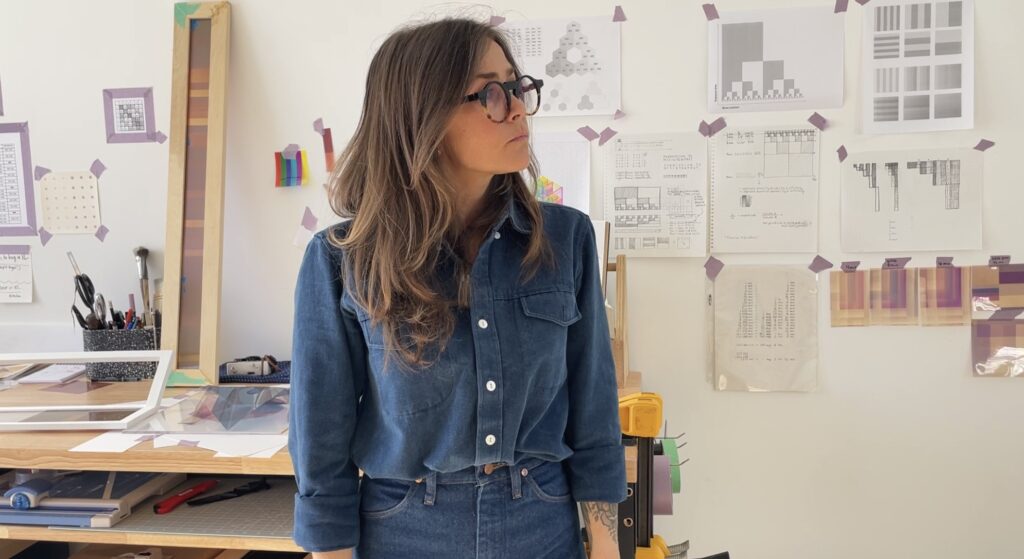
Shaina Gates is an artist working in experimental photography, using black and white film to produce transparent colorful images. Her work is built around mathematic and geometric structures, the dimensionality of time, materiality and optics, using light, surface, and limited chemistry.
Gates holds an MFA from the University of Pennsylvania (2016), an MAT in Art Education from the School of Visual Arts, NY (2008), and a BFA from the Rhode Island School of Design (2005). Her work has been featured in museum exhibitions including the Center for Maine Contemporary Art’s 2023 Biennial and the New England Triennial 2022 at the deCordova and Fruitlands Museums, as well as shows at the UNH Museum of Art and Cape Cod Museum of Art.
Recent solo exhibitions include: Specimina at the Experimental Photo Festival (Barcelona, 2024) and TESTSET at 3SArtspace (Portsmouth, 2023). Gates’s contributions to the field of experimental photography have also been recognized through selected group exhibitions including Pencil of Nature at Space538 (Portland, 2025), Air Index at Equivalent Behavior Space (London, 2024), and Shift/Plane/Density at Practice Gallery (Philadelphia, 2024).
In 2023, she received the prestigious Piscataqua Region Artist Advancement Grant from the New Hampshire Charitable Foundation, culminating in a 2024 exhibition at 3SArtspace.
Gates works out of her light filled studio in Kittery, Maine, where she also lives with her husband, one dog, and one cat.